The finish code on a sheet tells you how the surface was produced. It matters more than most buyers expect, because the surface is where corrosion starts and where dirt stays.
The mill finishes
No.1 — hot rolled, annealed and pickled. Dull, slightly rough, grey. Used on plate above 5 mm where the surface will be painted, buried or welded over.
2B — cold rolled, annealed, pickled, then given a light skin pass. Smooth, slightly reflective, the standard supply condition for sheet. Most fabrication starts here.
BA (bright annealed) — annealed in a controlled atmosphere so no scale forms. Bright and reflective without polishing. Common on tube and on decorative sheet.
The polished finishes
No.4 (satin, 150–180 grit) — the brushed look you see on commercial kitchen equipment. It hides fingerprints and scratches well and is easy to clean.
Hairline (HL) — a long, fine, continuous grain. Popular on lift cabins and door frames.
No.8 (mirror) — polished to a reflection. Beautiful and unforgiving: every scratch and fingerprint shows.
For hygienic process work
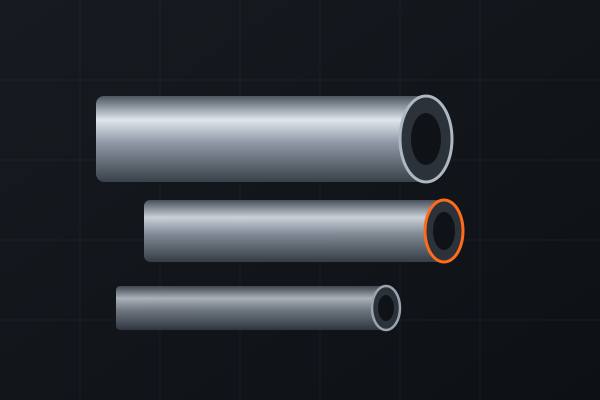
Roughness is what matters, not appearance. Dairy, food and pharma tubing is specified by Ra — internal surface roughness in micrometres. Ra ≤ 0.8 µm is the usual line for product contact; Ra ≤ 0.5 µm for cleaner duties. Below that, bacteria have nowhere to hold and CIP cleaning actually works.
Practical notes
- A smoother finish resists corrosion better — fewer crevices to trap chloride
- Directional finishes (No.4, hairline) must be laid with the grain running the same way on
adjacent panels, or the joint looks wrong
- PVD colour coating goes over a finished surface — mirror gives the deepest colour
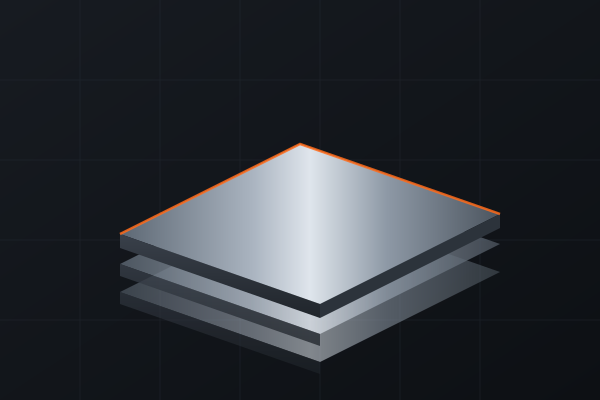
- Always order sheet with PVC film if it is going to site; removing scratches afterwards costs
more than the film
If you are matching an existing installation, send us a photograph and the panel size on WhatsApp — we can usually identify the finish from a picture.